Dim Sum Rush
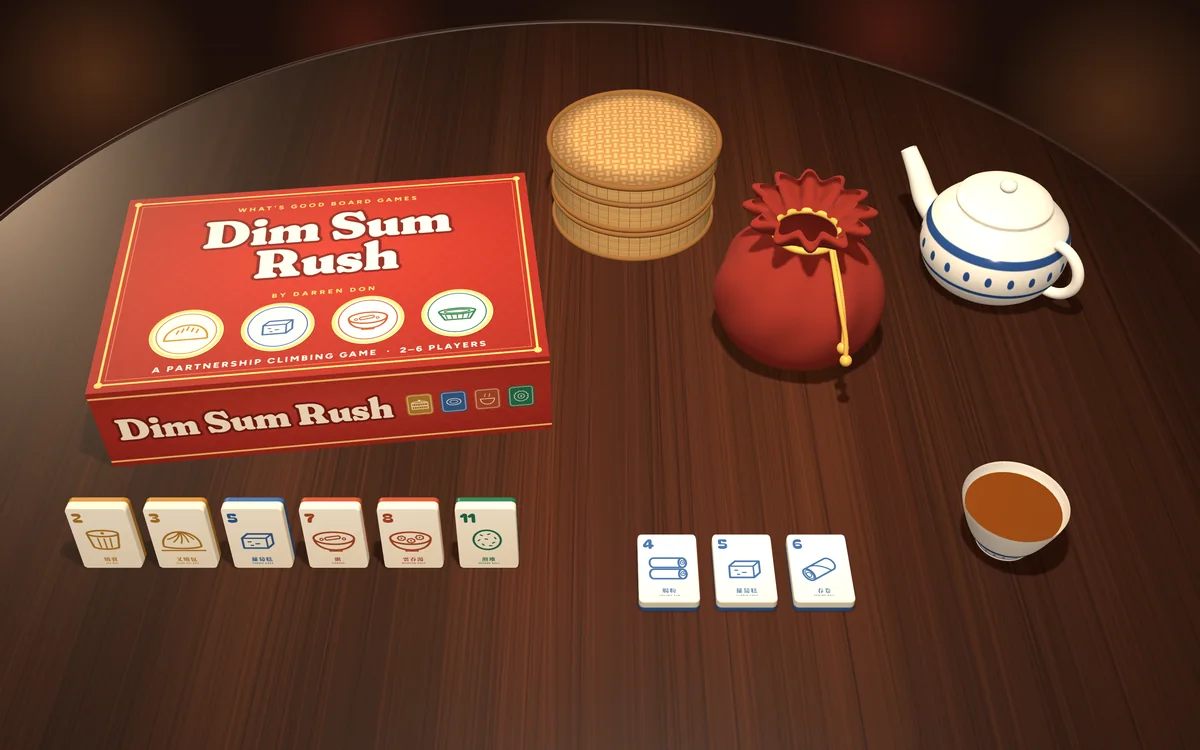
A partnership climbing game for 2–6 players, with a free-for-all mode, made for tiles or cards. Share them with your team, and empty every cart on your side first.
- Players
- 2–6 · teams at 4 and 6, or every player for themselves
- Genre
- Partnership Climbing · Free-for-All Mode
- For fans of
- Scout · Rummikub
- Length
- 30–45 minutes · 3 rounds
- Format
- Tiles or cards · same rules either way
- Components
- 84 tiles with a cloth bag, or 84 cards · rulebook
- Box
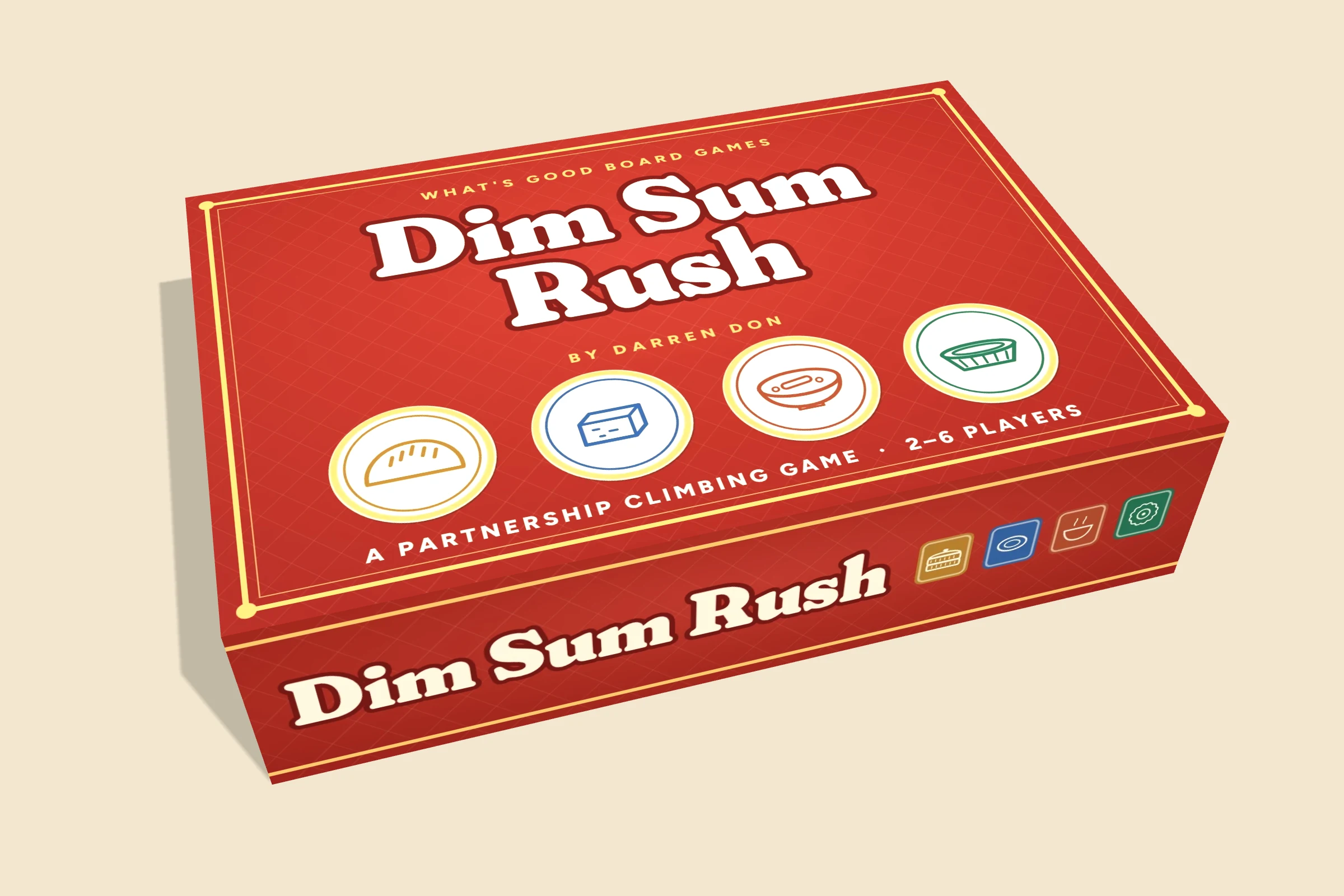
- Tiles: about 19 × 14 × 6 cm · Cards: about 11.5 × 9 × 3 cm, Tichu size
Overview
The pitch
Each team shares face-up tiles the other team can’t touch, so every tile you put out is a play only your partner can make. Your hand is your cart, in a fixed order you can never rearrange. The tile you put face up on your team’s trolley is how you help your partner out of a bad cart, and you’re always reading what the other team is setting up.
Teamwork without bidding
Partners coordinate through the tiles they share, not calls or bets. Scoring is one number: the losing team takes points for its fullest cart.
Passing is a real move
When you pass, you can fill an empty trolley spot or swap a tile. Passing is how you reshape your cart and set up your partner.
A way back into every trick
Chef's Specials, four of a number or a run of four from your own cart, beat any regular play so a team that's behind can take the lead back.
Plays at every count
Teams of 2 or 3 at 4 and 6 players, plus Every Server for Themselves for 2–6, where you share only with your neighbors.
Components
Twelve dishes, four bands
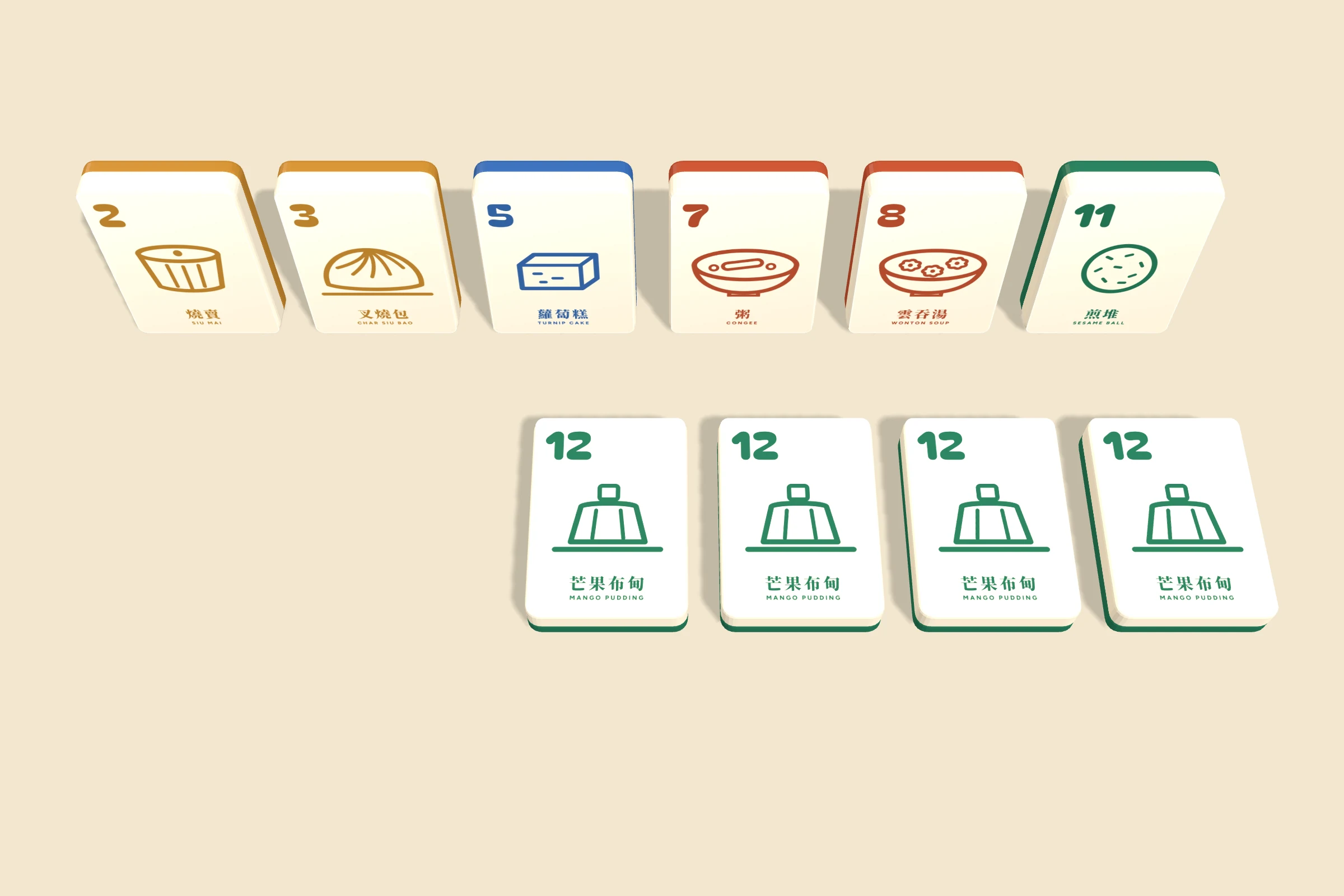
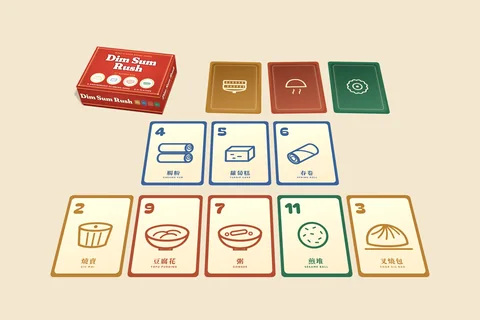
84 pieces, seven of each dish, as domino-thin tiles or as cards. Either way, the color of a piece's back tells you its range, so you always know roughly what an opponent is holding.
In the box
- 84Tiles or cards: 12 dishes × 7 copies, numbered 1–12 in four colored bands. As tiles, each is about 30 × 40 mm and 8 mm thick, a bone face bonded to a colored back; as cards, 84 poker-size cards with backs in the four band colors
- 1Cloth bag, with tiles. Setup is drawing from the bag; with cards, you shuffle and deal instead.
- 1Rulebook, including the Every Server for Themselves variant
The mockups show the tile version and the print-and-play kit uses cards; the game plays the same either way. Tiles or cards, final components, box size and finishes are open to discussion with a publisher.

Play
Try it right here
The full game runs below. No download or account needed.
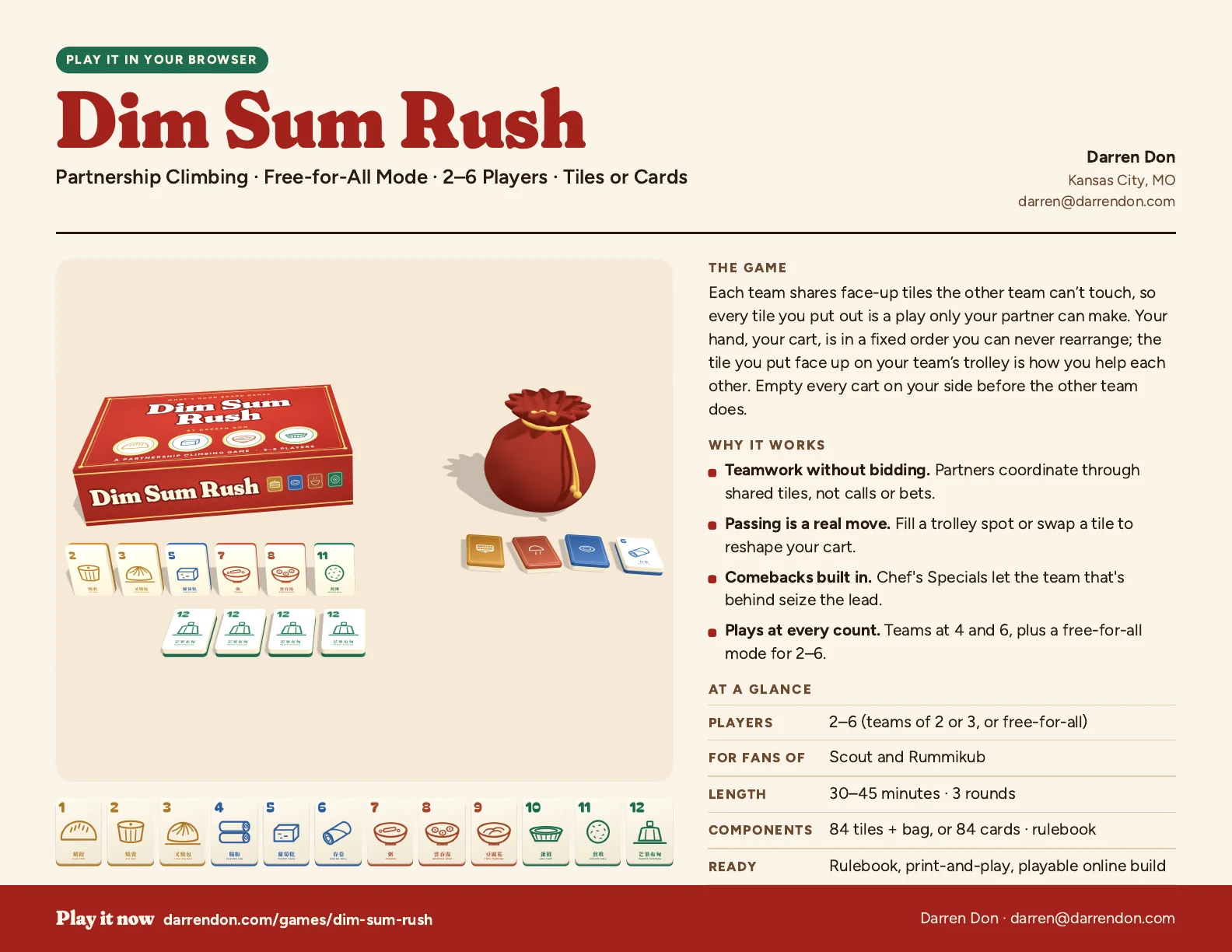
Sell sheet
One page for your review meeting
The pitch, key features, specs and components on a single landscape page, ready to print or forward.
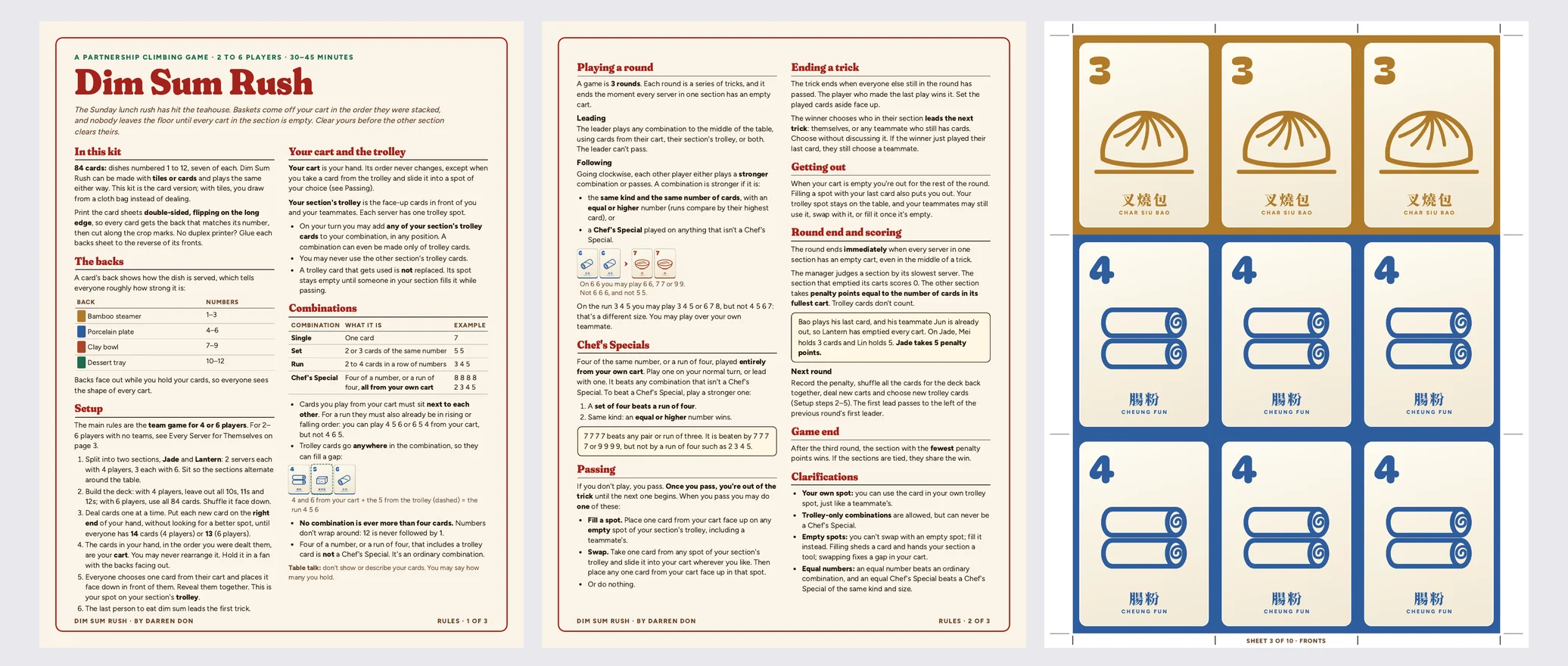
Print and play · on request
Want it on your table?
A 23-page kit: three pages of rules, then ten sheets holding all 84 cards with crop marks, each followed by its backs. Print double-sided and flip on the long edge so every card's back shows its serving vessel. It’s the card version of the game: shuffle and deal instead of drawing tiles from a bag. Email me and I’ll send it over.
Rules in brief
How it plays
The full rules, ready to read or print. They’re written for the card version; with tiles, you draw from the bag instead of dealing, and everything else is the same.
Your cart and the trolley
Your cart is your hand, in a fixed order you can never rearrange. The trolley is the face-up tile in front of each player. You may use your own team's trolley tiles in any combination.
Combinations
Play a single, a set of 2–3, or a run of 2–4. Tiles from your cart must sit side by side, and a run's cart tiles must already be in order. No combination is ever more than four tiles.
Following
Beat the table with the same kind and size at an equal or higher number, or with a Chef's Special: four of a number or a run of four, all from your own cart. A set beats a run.
Passing
Passing takes you out of the trick. When you pass you may fill any empty trolley spot on your side from your cart, or swap a cart tile with a trolley tile.
Leading
The trick winner picks who on their team leads next, themselves included.
Scoring
The round ends the moment every cart on one team is empty. The other team scores penalty points equal to its fullest cart. Play three rounds; fewest points wins.
Interested in Dim Sum Rush?
Ask for a prototype, or a walkthrough call with your team.